Numbers have unique power in public discourse. For instance, some past research has shown that reporting statistical information increases the credibility and quality of news for audiences, and medical messages are more trusted when they contain numbers.
But numbers have often been used in misleading ways. There is a long history of spurious numerical claims about climate change, public health, and immigration. Poor objective and subjective numeracy also mean many people struggle to judge statistics.
This makes numbers especially relevant to the study of mis/disinformation, yet there is surprisingly little research on the topic.
Using data from our in-depth, longitudinal qualitative fieldwork, in our new article we explore how people gauge the trustworthiness of numerical dis- and misinformation on personal messaging platforms.
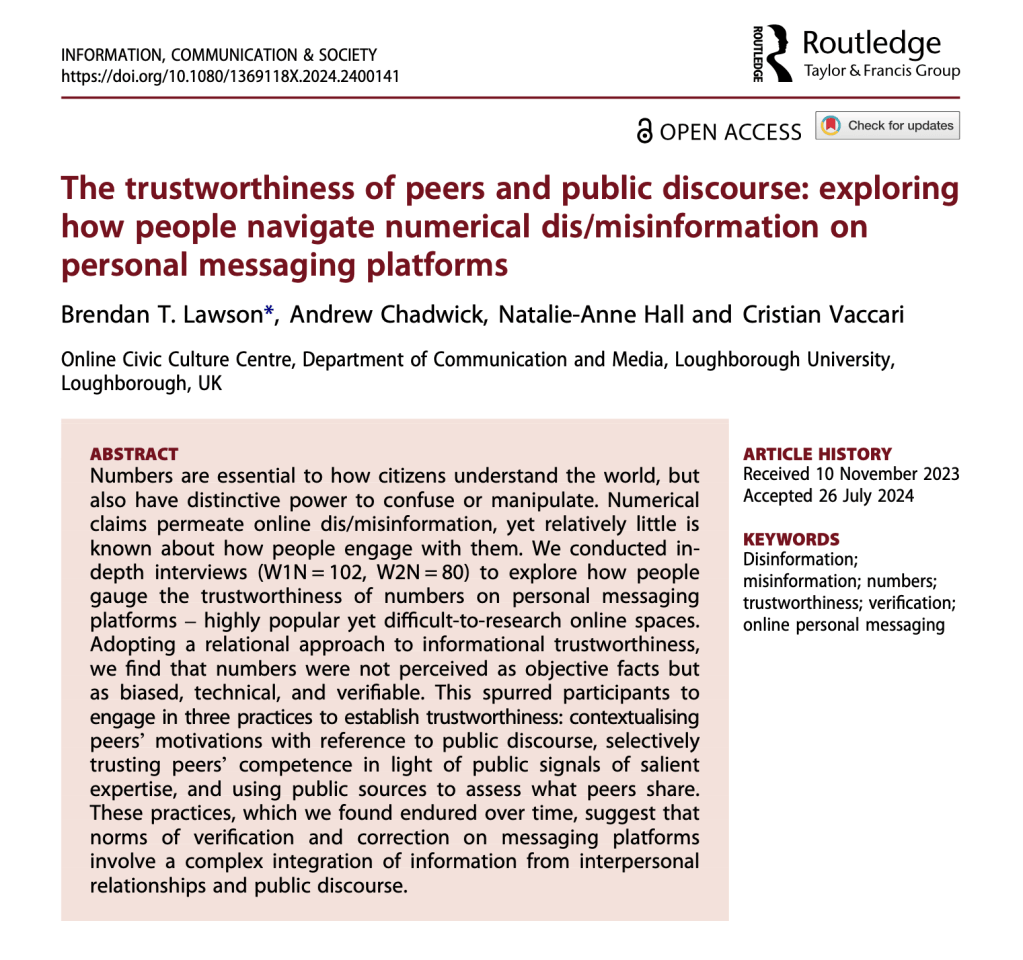
In The trustworthiness of peers and public discourse, out today in the journal Information, Communication and Society, we begin by further augmenting our relational theoretical framework for understanding how people assess trustworthiness online: the hybrid public-interpersonal communication environment.
We argue that research on trustworthiness and dis/misinformation would benefit from foregrounding relational interactions and interpersonal social experience. Trustworthiness in these spaces of interaction is not solely source-dependent but stems from the norms of verification and correction in people’s everyday social relationships of goodwill—another factor we think ought to be explored more broadly in studies of dis/misinformation. However, as we show, these norms also involve individuals placing these judgements in the context of their assessments of broader public discourse.
We show how this dialectical interrelationship works in three main sets of practices our 102 UK-based participants used to establish the trustworthiness of numerical information.
Trusting peers: contextualising peers’ motivations
Participants considered numbers on personal messaging platforms to be biased. To untangle this bias, people often referred to contextualising, with reference to public discourse, peers’ motivations for sharing numbers. Generally, this was used to identify untrustworthy peers. If a person was aligned to certain political parties, for example, participants would place their peers’ motivation within a broader political context to appreciate the bias of the numbers they shared.
Trusting peers: Expertise and reputation
Participants saw numbers as technical pieces of knowledge, relying on peers who had the expertise and reputation to understand quantitative information. Participants reported that they needed to evaluate the ability of peers to deal with the technicalities of numbers, and this was articulated through interpersonal constructions of expertise and reputation. At the same time, these assessments were made with reference to the public salience of the expertise and reputation, given what people were observing in public discourse. For example, during the height of the Covid pandemic, participants would refer to peers’ healthcare expertise as a key indicator of trustworthiness. This was often paired with an interpersonal assessment of peers as “rational,” “analytical,” or “scientific” in their approach to daily life. Participants anchored themselves to trustworthy peers by contextualising those peers’ competency, increasing their resilience to dis/misinformation in the process.
Trusting public discourse: checking and challenging
For some, the technical nature of numbers meant they were compelled to look to the public world to assess their trustworthiness. This involved participants coming across numbers on personal messaging platforms, engaging in a process of checking these numbers in public discourse and—in some cases—returning to their private conversations to challenge their peers. This unique form of lateral reading—a protection against vulnerability on personal messaging similar to the rule-making behaviour we found in our earlier study—involves actively moving from private to public and back again.
Implications and Recommendations
Four-fifths (80%) of UK internet users now use WhatsApp. With 94% of UK over-16s online, that is highly significant reach, and a close second to the top platform: YouTube.
Our findings could potentially inform new interventions to blunt the impact of numerical dis/misinformation in these important and, in many respects, unique online spaces.
People need to be able to distinguish between trustworthy and untrustworthy peers, especially if they do not feel confident in interpreting numerical information. Relying on peers who display expertise and reputation is a good starting point, but people might also be encouraged to assess peers’ motivations for sharing numbers even when the context is one of goodwill. A useful way to do this is to encourage people to read interpersonal motivations laterally, within a broader political context. But people also need tools, training, and confidence to move from personal messaging platforms to public discourse so they can evaluate numbers and reintroduce that knowledge into messaging.
Those in trustworthy positions in personal messaging interactions also need to take their responsibility seriously, and fresh attention should be paid to the power of individuals to operate as trusted sources in these new contexts.
Our holistic, relational approach provides a new way of understanding not just numerical dis/misinformation but other types as well – with the key benefit that it grounds analysis in people’s central everyday experiences online.

